
Why are my Walls Bowing?
If you have noticed bowing walls in your home, then there are various issues that could be at work. However, bowing walls are caused either by the presence of intense lateral pressure or a lack of necessary support in key areas of the structure. This either means an excess of hydrostatic pressure or the presence of foundation damage of some kind.
Hydrostatic Pressure
One of the most likely sources of extreme lateral pressure around a property is the presence of excessively high hydrostatic pressure. Hydrostatic pressure is a perfectly normal force. All properties deal with it to some degree, and homes are designed to withstand certain levels of hydrostatic pressure. The point at which issues arise is the moment that the level of hydrostatic pressure exceeds the ability of a property to withstand it. This is most likely to happen when a property has poor drainage capabilities or the weather is extremely wet.
In the humid and often changeable climate of North Carolina where heavy, clay-based soils are common, hydrostatic pressure can reach immense levels. What’s worse is that the lateral pressure created by soil saturation, in these cases, is exacerbated by the way that expansive soils increase in volume when they are saturated. This laterally applied pressure can cause bowing walls because of its proportionally low tensile strength.
Foundation Damage
As well as excessive lateral pressure, a lack of support can lead to bowing walls in a home. Your property’s foundation walls are load-bearing walls and must carry a huge amount of weight. While concrete has a huge compressive strength, it can be compromised if the weight on it is applied unevenly. This means that foundation problems like settlement and subsidence can wreak havoc on your property’s foundation walls and lead to them bowing.
Foundation problems also start in the soil and are heavily impacted by the presence or absence of moisture. As such, it is very common for bowing walls to be caused by a combination of foundation damage and high hydrostatic pressure around a property. This makes the process of diagnosing and repairing issues like this complex, but there are plenty of repair options.
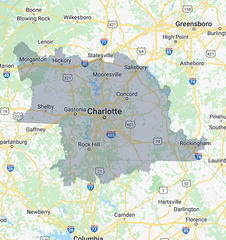
Our Locations
130 Performance Dr
Belmont, NC 28012
1312 Matthews-Mint Hill Rd.
Matthews, NC 28105