

Are Helical Piers Better Than Push Piers?
Helical piers and push piers are both forms of foundation piers. As such, neither is really better than the other. They are simply better for different kinds of properties and situations. Knowing when to deploy that kind of foundation pier is what makes professional services so effective. While this is not something that you as a homeowner need to be able to do, it does pay to know what the basic strengths and limitations of these products are.
Push piers are also called resistance piers, and this name is highly indicative of their role and strengths. Push piers are long, straight tubes that are hydraulically driven into the ground to find load-bearing soil and use the weight of the property to hold position. Once they are set in place, they are attached to the foundation footing to transfer the weight of property from the weak or unstable soil to this strong, stable strata. The limitations of these piers are simple: they cannot be installed at an angle, and they cannot be installed in homes where the foundation footing is badly cracked or fragmented.
Helical piers, by contrast, are piers with screw-like plates on the side. They are, in fact, screwed into the ground using hydraulic tools, and they use the torque generated by this process to essentially bite into the soil and distribute the weight of the property through the soil. This prevents further movement or deviation. These piers are good for homes that are too light to set push piers in place or that have foundation footings too badly fragmented to use resistance piers. These piers also can be installed at an angle if necessary, making them more versatile.
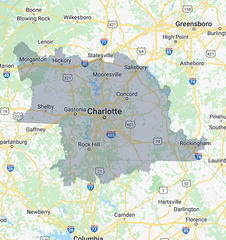
Our Locations
130 Performance Dr
Belmont, NC 28012
1312 Matthews-Mint Hill Rd.
Matthews, NC 28105